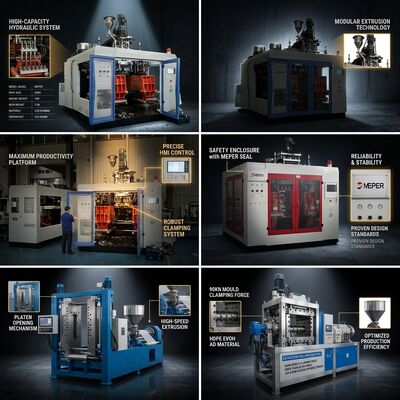
Surface defects on a blow moulded bottle are almost always a temperature story. Flow lines, sharkskin at the parison, dull patches and visible weld lines at the pinch-off all trace back to an uneven melt or a head running at the wrong temperature. This 10 litre HDPE machine is specified around thermal control rather than a single headline output number: four barrel zones across 15.85 kW and three independent head zones at 10 kW, plus a 0.28 kW screw cooling fan holding the feed throat steady.
Why the split matters: the feed section, compression section and metering section of an 80 mm, 24:1 screw each do a different job, and forcing them to share one setpoint means compromising one to satisfy another. With four zones, the feed section runs cool enough to avoid bridging, the compression zone provides controlled shear heating, and the metering zone is trimmed to deliver the exact melt temperature the parison needs.
Thermal Control Features
- Four barrel heating zones, 15.85 kW total: each section of the screw is set independently so shear heat and conduction heat can be balanced rather than one masking the other.
- Three head heating zones, 10 kW: the die head is decoupled from the barrel, so parison surface finish can be tuned without disturbing melt history.
- Screw cooling fan, 0.28 kW: holds the feed throat temperature constant, which stabilises the solids conveying rate and therefore parison weight.
- Stable 90 kg/h HDPE output: consistent melt viscosity is what allows a constant parison length rather than operator compensation at every cycle.
- Improved surface finish: correct metering temperature eliminates the dull bands and flow marks that appear when melt is too cool at the die lip.
- Weld line strength: parison temperature uniformity at the pinch-off directly determines seam strength on 10 litre containers.
Technical Specifications
| Parameter | Specification |
|---|
| Screw heating zones | 4 zones |
| Screw heating power | 15.85 kW |
| Screw cooling fan power | 0.28 kW |
| Head heating zones | 3 zones |
| Head heating power | 10 kW |
| Plasticizing capacity (HDPE) | 90 kg/h |
| Screw diameter | 80 mm |
| Screw L/D ratio | 24:1 |
| Max product volume | 10 L |
| Total machine power | 80 kW |
Diagnosing Surface Problems Through Zone Data
When a bottle shows flow lines running vertically along the body, the usual cause is a metering zone that is too cool: the melt enters the head with elastic memory and the parison surface stretches unevenly as it drops. A two to five degree increase in the final barrel zone, with head temperature held constant, frequently resolves it without touching anything else.
Dull or matte patches point the other way, toward a head that is running cold relative to the melt, causing premature skin formation at the die lip. Because head heating has its own three zones, this can be corrected independently instead of overheating the whole barrel and degrading the resin in the process. That separation is the practical difference between a machine with zone control and one with a single temperature loop.
Frequently Asked Questions
How many heating zones does a 10 litre HDPE machine actually need?
Four barrel zones plus three head zones is the configuration we recommend for mixed 1 to 10 litre production. Fewer zones force compromises between feed, compression and metering sections, which shows up as inconsistent parison weight and surface defects on demanding parts.
Why does the head need separate temperature control?
The head has a much smaller melt volume and a larger surface area than the barrel, so its heat loss profile is completely different. Separate zones keep the die lip at the temperature that gives a clean surface even when the barrel is running hotter for dispersion.
What output stability can I expect through a shift?
With the feed throat cooled and zones in steady state, parison weight drift over a shift is small enough that operators are not adjusting the programmer every hour. That stability is what makes automatic weight control viable if you add it later.


 Your message must be between 20-3,000 characters!