A blow moulding machine that needs half a day to change a mould is a machine that only makes sense for one product. This MP80D configuration is arranged for plants running mixed order books: a 1 to 4 head die set, a 520 x 460 mm mould envelope and 540 mm of plate stroke mean the same platform covers a shampoo bottle run in the morning and a 10 litre container run in the afternoon without calling in a fitter.
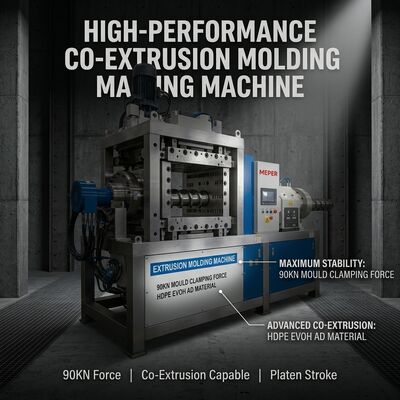
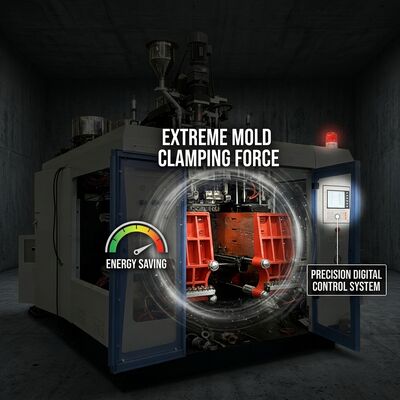
The 150 kN clamp is not oversized for the largest mould the machine accepts, which matters for changeover. When a clamp is run near its limit, platens and guide pins take the load and alignment shifts gradually; when it runs with margin, moulds seat the same way every time and neck dimensions hold from the first shot after changeover rather than drifting in over a hundred.
Changeover and Mould Flexibility
- 1 to 4 die heads: swap head assemblies to match the order book instead of pairing one machine to one product family.
- 520 x 460 mm mould envelope: accepts single-cavity moulds for 10 litre containers and multi-cavity moulds for small PE and PP bottles.
- 540 mm plate stroke with 220-620 mm opening: deep moulds and shallow moulds both mount without adapter plates.
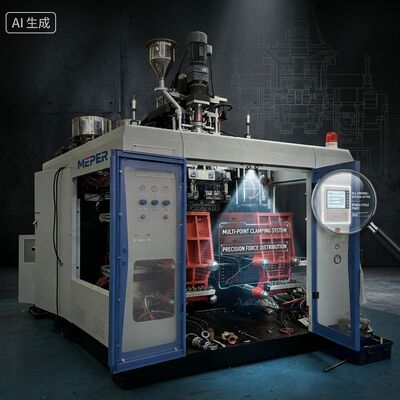
- Clamp margin at maximum mould size: 150 kN against the full envelope keeps alignment stable through repeated mould changes.
- Platen mounting pattern: standardised clamping slots so existing moulds with common backplate dimensions transfer directly.
- PE and PP optimisation: temperature recipes for both resins stored in the controller, recalled in seconds at changeover.
Technical Specifications
| Parameter | Specification |
|---|
| Die head options | 1, 2, 3 or 4 heads |
| Mould clamping force | 150 kN |
| Max mould size (W x H) | 520 x 460 mm |
| Plate stroke | 540 mm |
| Platen opening stroke | 220-620 mm |
| Max product volume | 10 L |
| Applicable materials | PE, PP, PVC, PA |
| Plasticizing capacity (HDPE) | 90 kg/h |
| Machine weight | 8.2 ton |
What a Fast Changeover Is Worth
Consider a plant running three bottle families per week, each needing two mould changes. Saving 60 minutes per changeover returns six hours of machine time a week, which on a machine producing at 90 kg/h is a meaningful amount of saleable output. The practical enablers are a standardised platen pattern, head assemblies that are indexed rather than aligned by eye, and controller recipes that restore temperatures and screw speeds for each resin and mould combination.
There is a quality dimension too. Every changeover is an opportunity for alignment error that shows up later as uneven flash or a leaking neck. Machines that seat moulds consistently reduce the need for first-off inspection loops and the scrap that goes with them, and they make small batch production economically viable rather than something to be avoided.
Frequently Asked Questions
Can I mount my existing moulds on this machine?
In most cases yes, provided the mould falls within the 520 x 460 mm envelope and the backplate matches common platen slot dimensions. We ask for mould drawings before order confirmation so any adapter plate can be manufactured with the machine rather than after delivery.
How long does a typical head change take?
Changing between head configurations is a mechanical task measured in hours, not minutes, so it is planned work rather than something done daily. Mould changes within a head configuration are the frequent operation and typically take well under an hour with the standardised platen pattern.
What is the largest PE or PP container this machine makes?
10 litres per cavity. At that size the practical configuration is usually one or two heads, because four 10 litre cavities would exceed the 90 kg/h plasticizing rate and leave the clamp waiting on the extruder.


 Your message must be between 20-3,000 characters!