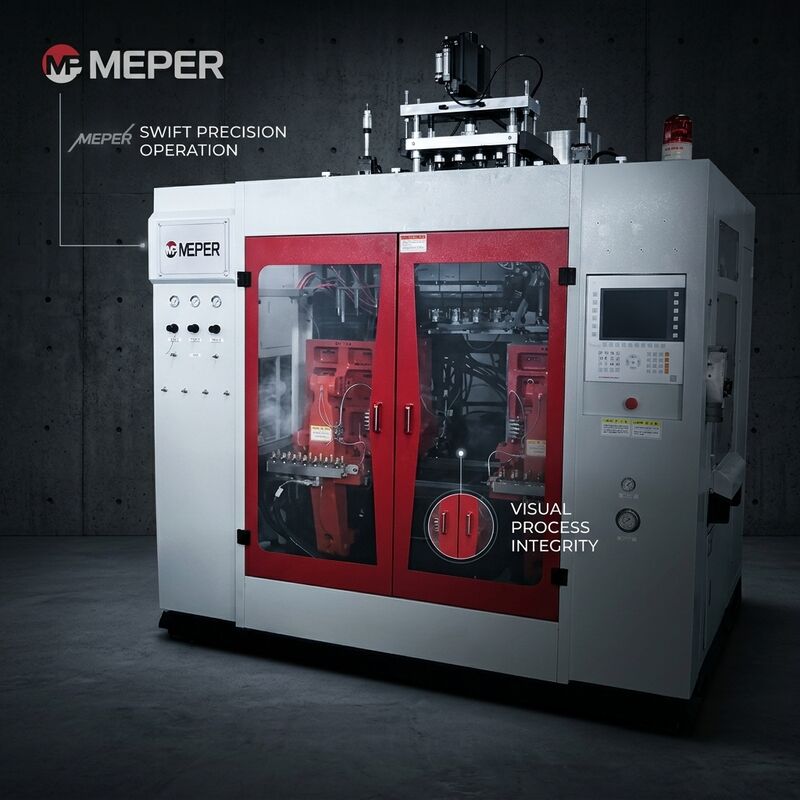
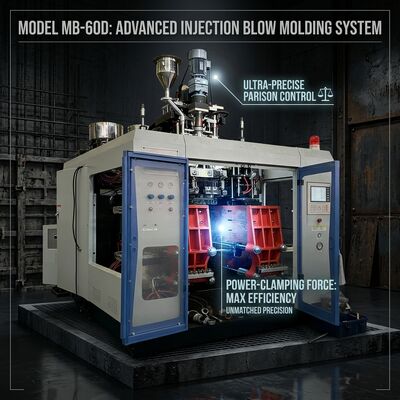
Chemical and agrochemical packaging carries obligations that ordinary bottle work does not: closures that seal against aggressive contents, walls that resist environmental stress cracking, and neck dimensions that match tamper-evident caps to the millimetre. The MP80D extrusion blow moulder is specified for exactly this segment, producing containers up to 10 litres in PE, PP, PVC and PA with the dimensional repeatability that chemical packers audit for.
The practical advantage is the combination of a 90 kg/h plasticizing rate with a 150 kN clamp and 520 x 460 mm mould capacity. That envelope covers pesticide bottles, disinfectant containers, antifreeze jugs, engine oil bottles and laboratory chemical packs on one platform, with 1 to 4 die heads available depending on whether the priority is volume or wall-thickness control.
Built for Chemical Packaging
- Sealing surface integrity: stable clamp force and controlled parison temperature preserve the neck finish that tamper-evident caps depend on.
- ESCR-friendly processing: gradual melting through a 24:1 screw avoids the over-shearing that degrades stress crack resistance in HDPE chemical bottles.
- Material range for content compatibility: PE for detergents and oils, PP for solvents, PVC for acids and PA where barrier properties are needed.
- 40 L/min cooling water specification: adequate mould cooling is essential on thick-walled chemical containers where cycle time is cooling-limited.
- 1-4 die head options: single head for large 10 litre containers, multi-head for small agrochemical bottles.
- 0.6-0.8 MPa air supply: standard plant air is sufficient, so no special compressor upgrade is needed.
Technical Specifications
| Parameter | Specification |
|---|
| Applicable materials | PE, PP, PVC, PA |
| Max product volume | 10 L |
| Mould clamping force | 150 kN |
| Plasticizing capacity (HDPE) | 90 kg/h |
| Number of heads | 1 / 2 / 3 / 4 |
| Cooling water volume | 40 L/min |
| Air pressure | 0.6-0.8 MPa |
| Compressed air volume | 1.5 m3/min |
| Total machine power | 80 kW |
| Machine weight | 8.2 ton |
Container Types Commonly Produced
- Pesticide and herbicide bottles from 500 ml to 5 L with calibrated dosing necks.
- Disinfectant and bleach containers requiring chlorine-resistant HDPE.
- Antifreeze and coolant jugs with wide-mouth openings and integrated handles.
- Engine oil and lubricant bottles with offset necks for clean pouring.
- Laboratory and industrial chemical packs in PP and PA for solvent resistance.
- Fertiliser liquid containers for agricultural distribution networks.
Compliance and Traceability
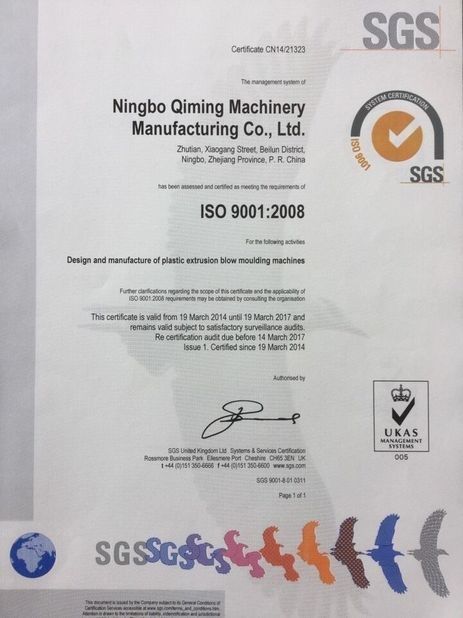
Chemical packaging buyers increasingly ask for documented process control. The controller records zone temperatures, screw speed and cycle counts, which gives a defensible production record when a customer audits dimensional stability or requests batch traceability. Combined with the CE and ISO 9001 certification of the machine build, this shortens the supplier approval process considerably.
We also advise on mould steel selection for aggressive contents. For PVC and acid-containing products, hardened inserts at the pinch-off and neck area reduce maintenance and keep the sealing surface within tolerance over a long tool life.
Frequently Asked Questions
Which material should I choose for a pesticide bottle?
HDPE is the default for most agrochemical containers because of its chemical resistance and cost. PP is chosen where the contents are solvent-based, and PA is used when barrier performance against volatile components is required. The final decision should be confirmed with your resin supplier against the specific formulation.
Can the machine produce containers with calibrated dosing necks?
Yes. Neck accuracy comes from the mould and from stable parison temperature at the head. Multi-zone head heating keeps the neck area consistent so the cap fit remains within the specified torque and seal requirement.
What cooling setup do thick-walled chemical containers need?
The machine specifies 40 L/min of cooling water. On thick-walled containers the mould circuit design and chiller capacity dominate cycle time, so we recommend confirming mould cooling layout at the tooling stage rather than after installation.


 Your message must be between 20-3,000 characters!