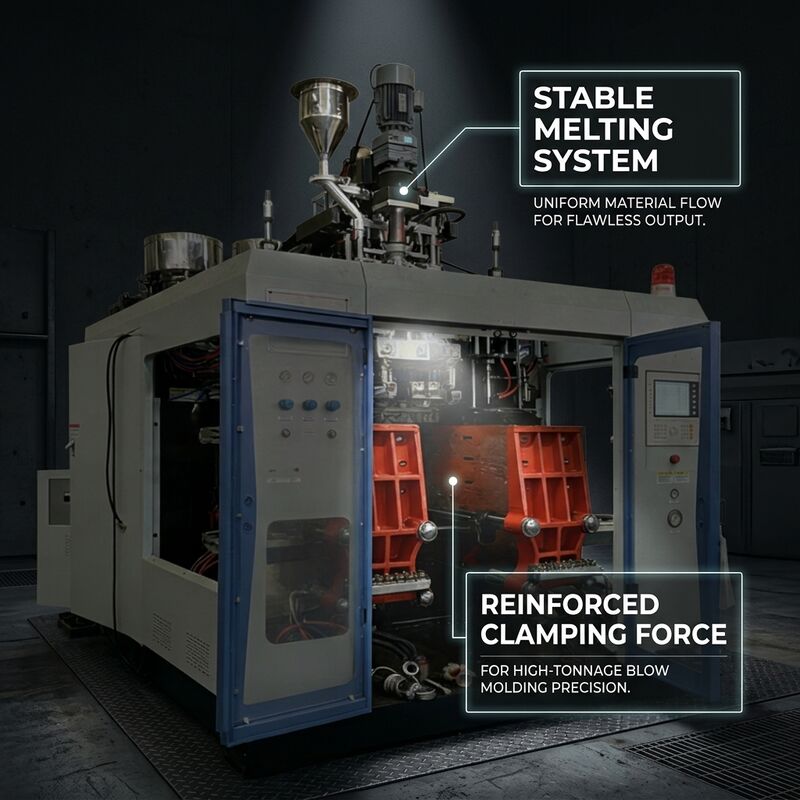
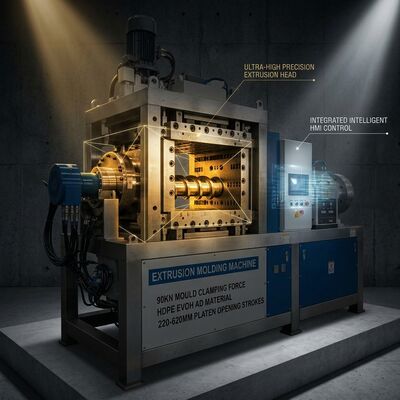
Most hollow blow molding enquiries start with one question: will the machine run the resin I already buy? The MP80D answers that with a deliberately broad material envelope. The same 80 mm, 24:1 screw processes high density polyethylene, polypropylene, polyvinyl chloride and polyamide, with barrel setpoints stored as recipes so switching from HDPE jerry cans to PP cosmetic bottles is a menu selection rather than a mechanical rebuild.
HDPE remains the workhorse. At 90 kg per hour plasticizing capacity, the machine keeps a dual station clamp fed with thick-walled parisons for jerry cans and industrial drums up to 10 litres, where wall thickness and drop resistance matter more than cycle time. Because the barrel is heated in four independent zones and the head in three, the higher melt index grades used for large containers and the stiffer, high molecular weight grades used for chemical packaging can both be run without scorching or unmelt.
Material Handling Capability
- PE compatibility: HDPE and LDPE from 0.2 to 1.2 MI, the standard range for jerry cans, detergent bottles and industrial containers.
- PP compatibility: suited to clarified and impact copolymer grades for cosmetic and personal care packaging that needs a glossy surface.
- PVC compatibility: a gently rising temperature profile across four zones keeps thermal degradation under control on rigid PVC bottles.
- PA compatibility: nylon grades for barrier and hot-fill applications run at the high end of the temperature range with head heating stabilised separately.
- 90 kg/h HDPE output: enough parison throughput for thick-walled 10 litre cans without stretching cycle time.
- Recipe-based changeover: material profiles saved in the controller cut colour and resin changeover to a purge and a setpoint recall.
Technical Specifications
| Parameter | Specification |
|---|
| Applicable materials | PE, PP, PVC, PA |
| Plasticizing capacity (HDPE) | 90 kg/h |
| Max product volume | 10 L |
| Screw diameter | 80 mm |
| Screw L/D ratio | 24:1 |
| Screw heating zones | 4 zones / 15.85 kW |
| Die head heating zones | 3 zones / 10 kW |
| Extrusion motor power | 30 kW |
| Number of heads | 1 / 2 / 3 / 4 |
| Total machine power | 80 kW |
Jerry Can Production in Practice
A 10 litre HDPE jerry can is a demanding part. It has a deep body, a heavy handle section and a base that must survive drop testing when filled. Parison programming and melt temperature dominate the outcome: too cold and the handle section will not blow out cleanly, too hot and the base thins during inflation. The independent head heating on this machine lets the die lip run slightly hotter than the barrel, which is usually the adjustment that fixes a stubborn handle.
For agrochemical and automotive fluid containers, chemical resistance of the virgin resin does the heavy lifting, but the processing must not degrade it. Controlled shear history through a 24:1 screw, rather than short-screw high-speed melting, keeps molecular weight distribution intact so the finished can retains its environmental stress crack resistance.
Frequently Asked Questions
Can one machine really run PE, PP, PVC and PA?
It can, within each material's temperature and shear limits. The mechanical hardware is identical; what changes is the temperature profile, screw speed and cooling settings. PVC needs particular care with residence time, so we supply a recommended purge and shutdown sequence with the machine.
What wall thickness tolerance can I hold on a 10 litre HDPE can?
Wall thickness is set mainly by parison programming and mould cooling rather than by the extruder. With a properly designed mould and stable head temperature, typical wall thickness variation on a 10 litre can falls within the range your drop test requires, and we help tune the profile during commissioning.
Is regrind acceptable in jerry can production?
Yes, in controlled proportions. Most plants run 20-30% regrind blended with virgin HDPE. Heavily filled or high molecular weight compounds should be trialled carefully, because regrind reduces ESCR even when processing parameters are correct.


 Your message must be between 20-3,000 characters!