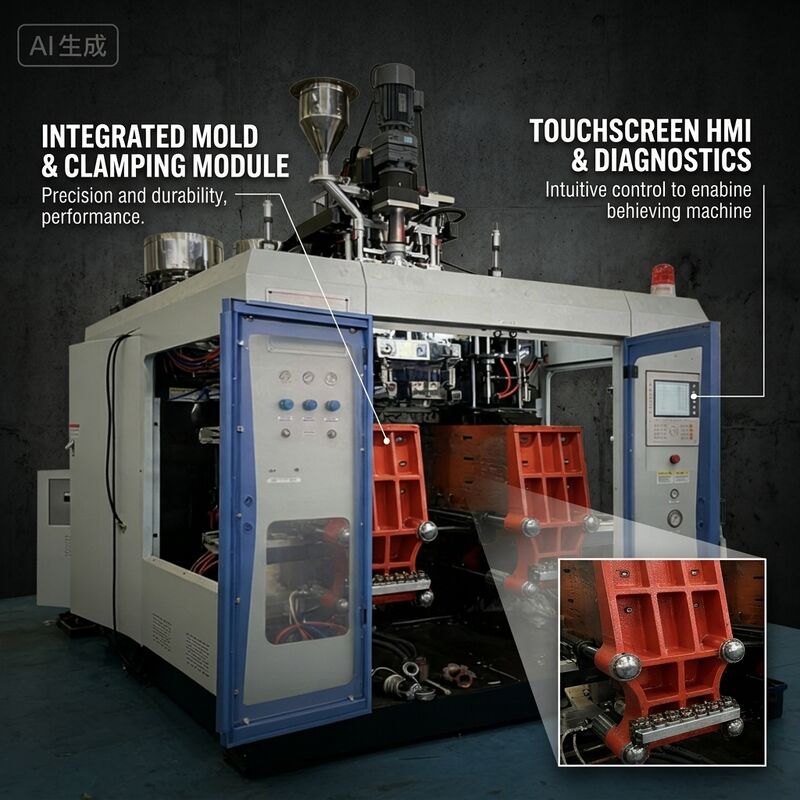
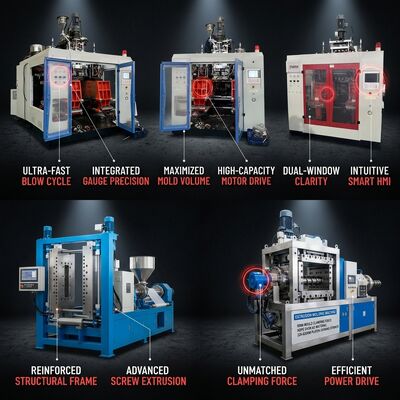
Flash is expensive twice: once as wasted resin and again as the labour needed to trim it. The dual station clamp on the MP80D is built around a 150 kN clamping force applied through reinforced platens with a 540 mm stroke, keeping the two mould halves square under blow pressure so the pinch-off line stays crisp and the flash band stays thin.
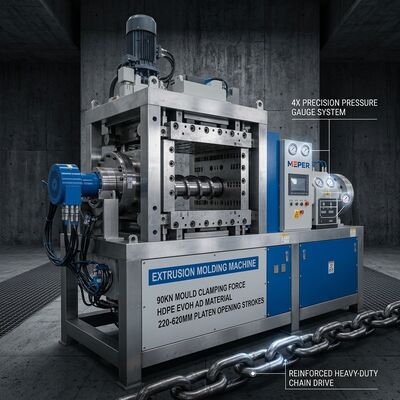
Geometry matters as much as force. The platen opening travels between 220 and 620 mm, which gives enough daylight for deep 10 litre container moulds while still allowing a short, fast closing stroke on shallow bottle moulds. Maximum mould size is 520 x 460 mm, and the 8.2 tonne machine frame keeps vibration low so the clamp does not drift out of alignment over years of two-shift operation.
Clamp and Mould Performance
- 150 kN clamping force: holds multi-cavity moulds shut against internal blow pressure, limiting flash and preserving the pinch-off edge on the container base.
- Reinforced platens: distribute force evenly across the mould face so outer cavities are not starved of pressure.
- 540 mm plate stroke: a long, guided stroke that stays parallel through the full travel, protecting mould guide pins.
- 220-620 mm opening: adjustable daylight for shallow bottles and deep jerry can moulds on the same machine.
- Dual station layout: two clamping positions share one extruder, so one station drops and re-clamps while the other blows.
- 8.2 ton frame mass: dampens clamp shock and keeps alignment stable instead of relying on frequent re-shimming.
Technical Specifications
| Parameter | Specification |
|---|
| Mould clamping force | 150 kN |
| Plate stroke | 540 mm |
| Platen opening stroke | 220-620 mm |
| Max mould size (W x H) | 520 x 460 mm |
| Number of stations | Dual station |
| Machine dimension (L x W x H) | 4 x 2.3 x 2.5 m |
| Machine weight | 8.2 ton |
| Max product volume | 10 L |
| Air pressure required | 0.6-0.8 MPa |
| Compressed air volume | 1.5 m3/min |
| Cooling water volume | 40 L/min |
Why Clamp Stability Shows Up in Your Scrap Rate
A clamp that loses force over a shift does not fail suddenly. It shows up as a slow drift in flash thickness, then as trimming complaints, then as rejected bottles at the leak tester. Because the MP80D clamp is specified at 150 kN with platens sized for a 520 x 460 mm mould, the machine is not operated at the edge of its capability on typical 5 to 10 litre work, which is where alignment problems usually begin.
The dual station arrangement also improves mould life. Each station completes a full open-close cycle with a defined dwell, so the moulds are not held shut longer than the blow and cool phase requires. Guide pins and pinch-off inserts see fewer unnecessary cycles per shift than on a single station machine running the same output.
Frequently Asked Questions
Is 150 kN enough for a 10 litre container mould?
For the container sizes this machine is designed around, yes. Clamp requirement scales with the projected area of the container and the blow pressure used. A 10 L container at typical blow pressure sits comfortably inside the 150 kN rating, and we confirm the calculation against your specific mould drawing before shipment.
What does the 220-620 mm opening range actually control?
It is the usable daylight between platens. Deep moulds for tall jerry cans need the upper end; shallow bottle moulds use the lower end so the closing stroke is short and cycle time is not wasted on travel.
How is the clamp pressure maintained over long runs?
Hydraulic pressure is set and monitored through the control system, and the toggle and platen assembly is over-specified for the rated force. Operators record clamp pressure at shift start, and any drift is visible long before it affects part quality.
Can the dual station run two different moulds at once?
The stations are mechanically independent, so two mould sets can be mounted. In practice most plants run matched moulds to keep parison timing identical, but running a development mould on one station and a production mould on the other is a common way to trial new designs.


 Your message must be between 20-3,000 characters!