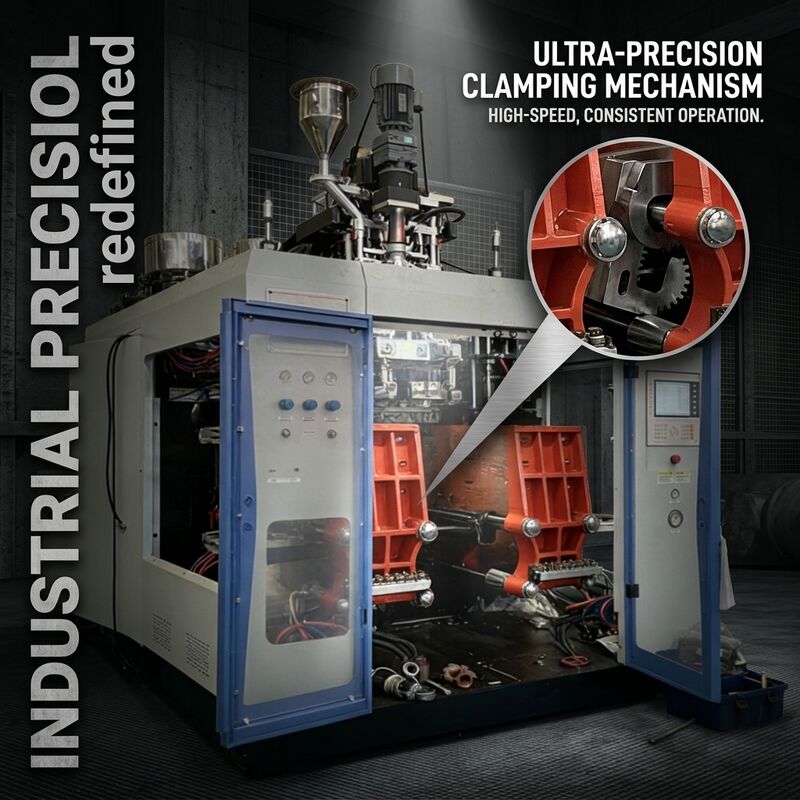
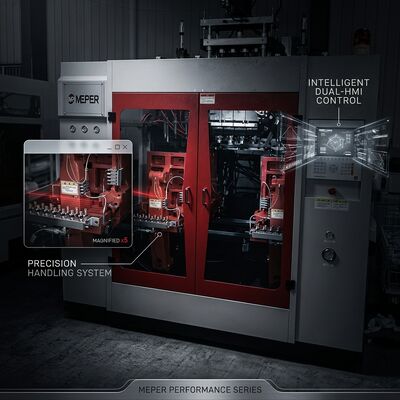
The MP80D is an 80 mm screw extrusion blow moulding machine engineered for plants that live or die by melt consistency. The barrel runs a nitrided screw with a 24:1 length-to-diameter ratio, so pellets are compressed, sheared and homogenised across a longer flight path instead of being flash-melted in a short zone. Longer residence time at controlled temperature is what separates a stable parison from one that sags, streaks or traps gas.
Power is delivered by a 30 kW extrusion motor working against four independently controlled barrel heating zones rated at 15.85 kW in total, with a dedicated 0.28 kW screw cooling fan holding the feed throat at a constant temperature. Under HDPE the machine plasticises up to 90 kg per hour, a figure that is achieved with a single screw rather than a larger, thirstier unit, which keeps power draw and screw wear predictable over multi-shift operation.
Key Features
- 80 mm screw, 24:1 L/D: the extended compression zone plasticises PE and PP gradually, producing a homogeneous melt with fewer unmelted particles and less internal stress in the finished bottle.
- 90 kg/h HDPE plasticizing capacity: matched to double station clamping so parison delivery and mould cycling stay in step instead of one starving the other.
- Four barrel heating zones with 15.85 kW total power: each zone is set independently, letting operators run a hotter feed section and a cooler metering section for resins with narrow processing windows.
- 30 kW extrusion motor: high torque at low screw speed holds output steady when regrind content fluctuates between batches.
- 3-zone die head heating (10 kW): the head is temperature-controlled separately from the barrel so parison surface quality is not disturbed by screw recovery.
- 10 L maximum product volume: one screw configuration covers bottles and containers from 500 ml up to 10 L without hardware changes.
Technical Specifications
| Parameter | Specification |
|---|
| Screw diameter | 80 mm |
| Screw length/diameter ratio | 24:1 |
| Plasticizing capacity (HDPE) | 90 kg/h |
| Screw heating zones | 4 zones |
| Screw heating power | 15.85 kW |
| Screw cooling fan power | 0.28 kW |
| Extrusion motor power | 30 kW |
| Die head heating zones | 3 zones |
| Die head heating power | 10 kW |
| Max product volume | 10 L |
| Number of die heads | 1 / 2 / 3 / 4 |
| Mould clamping force | 150 kN |
Where the Screw Configuration Pays Off
Processors running coloured HDPE detergent bottles notice the difference first: colour dispersion depends on shear history, and a 24:1 screw gives masterbatch enough flight length to break down and distribute evenly. The same applies to calcium-carbonate filled compounds, where short screws tend to leave agglomerates that show up as white speckles on the bottle wall.
For PP and PVC work the independent zone control matters more than raw output. PVC in particular demands a gently rising temperature profile with no hot spots, and the ability to trim the metering zone by a few degrees is often the difference between a clean parison and one with burn marks at the die lip.
Frequently Asked Questions
What real output should I expect from the 90 kg/h rating?
The 90 kg/h figure is measured on virgin HDPE at steady state. With 20-30% in-house regrind, expect roughly 80-85 kg/h, and with heavily filled compounds somewhat less. Output is set by screw speed and back pressure, so the rated figure is a ceiling rather than a fixed rate.
Does the screw handle both PE and PP without changing hardware?
Yes. The same 80 mm screw processes PE, PP, PVC and PA within their individual temperature profiles. Only the zone setpoints change, which is stored as a recipe on the control panel so operators switch products without mechanical work.
How is melt temperature controlled when running thin-wall bottles?
Three methods work together: the four barrel zones, the separate 3-zone head heating, and the screw cooling fan at the feed throat. Thin-wall work usually runs a slightly cooler metering zone and a marginally hotter head to keep parison strength while avoiding surface chilling.
Packing, Installation and Support
Each machine is shipped in a seaworthy wooden case with the screw, die head and control cabinet braced separately, and the MP80D fits a single 40HQ container at 4 x 2.3 x 2.5 m and 8.2 tonnes. Commissioning support, spare screw and barrel quotations, and a full parameter sheet in English are provided with every unit.


 Your message must be between 20-3,000 characters!