Why preform economics are machine economics
On a 500 ml water bottle, the preform usually carries 55–70% of total packaging cost. That one number explains why bottlers who buy on purchase price end up with a higher cost per bottle than competitors running a machine that costs 20% more but cycles two seconds faster. Cycle time, cavitation efficiency and intrinsic viscosity (IV) retention are the three levers — and all three are decided at the injection stage.
1. Cycle time: cooling, not injection, is the bottleneck
In a typical 28 mm/1810-neck water preform, injection takes 0.6–1.2 seconds, while cooling plus mould open and ejection consume 50–65% of the cycle. A machine with a 301 g/s injection rate and a 70 mm screw at 26:1 L/D can fill a 32-cavity mould quickly, but if the cooling circuit is undersized or the ejector stroke is short, the robot arrives late and the cycle stretches. Cycle ranges we see on production floors:
- Water preform, 13–19 g, 24–48 cavities: 9–13 seconds
- CSD preform, 22–28 g, thick wall: 16–22 seconds
- Edible-oil preform, 30–45 g: 22–30 seconds
Our MZ-K2-320 platform is commonly quoted at a 20-second cycle for a mineral-water preform mould — a figure that only holds when chiller capacity, water distributor layout and take-out robot are sized together with the machine.
2. Match cavitation to clamp tonnage, not to ambition
Cavity pressure inside a PET preform mould can reach 80–120 MPa. Required clamp force is roughly projected area multiplied by cavity pressure, plus a 10–20% safety margin. A 2800 kN machine such as the MZ280MD-PET (tie-bar spacing 610 × 560 mm, minimum mould height 200 mm, maximum 630 mm, ejector 70 kN over 185 mm) comfortably carries most 24–32 cavity water preform moulds. A 3200 kN MZ-K2-320 with a 615 mm opening stroke is the safer choice once you move to 48 cavities or thick-wall CSD tooling.
| Parameter | MZ280MD-PET | MZ-K2-320 |
|---|
| Screw diameter | 70 mm | 65 / 70 / 75 mm |
| Screw L/D ratio | 26:1 | 21:1 / 21:1 / 19.6:1 |
| Shot weight (PET) | 1163 g | 966 / 1120 / 1286 g |
| Injection pressure | 124 MPa | 175 / 152 / 133 MPa |
| Injection rate | 301 g/s | Screw stroke 320 mm |
| Clamp force | 2800 kN | 3200 kN |
| Space between tie bars | 610 × 560 mm | Opening stroke 615 mm |
3. IV loss: the invisible quality cost
Every 0.01 dl/g of IV lost during moulding reduces the top-load and stress-crack resistance of the blown bottle. In practice, an IV drop above 0.02 dl/g points to one of four causes: insufficient drying with resin moisture above 50 ppm or a dew point that never reaches −40 °C; excessive melt temperature; long residence time in an oversized barrel; or shear damage from a screw too short for the shot. A dedicated PET screw package — large diameter, 26:1 L/D, low-speed high-torque hydraulic motor for stable plasticising, four or more PID-controlled barrel zones and a spring or hydraulic nozzle matched to tonnage — addresses the last two. IV should be verified on the finished preform per ASTM D4603, not only on incoming resin.
4. Pre-purchase checklist
- Confirm clamp force against real cavity count and cavity pressure, not against the catalogue’s “maximum mould size”
- Check ejector force and stroke against your heaviest preform, counting the runner
- Verify barrel heating zones, nozzle type and whether a dehumidifying dryer is included
- Ask whether a preform conveyor socket and enlarged platen holes come as standard
- Request a factory acceptance test on your own mould, with cycle time logged shot by shot
- Compare measured kWh per 1000 preforms, servo versus variable pump, at the same cycle
A note on the numbers
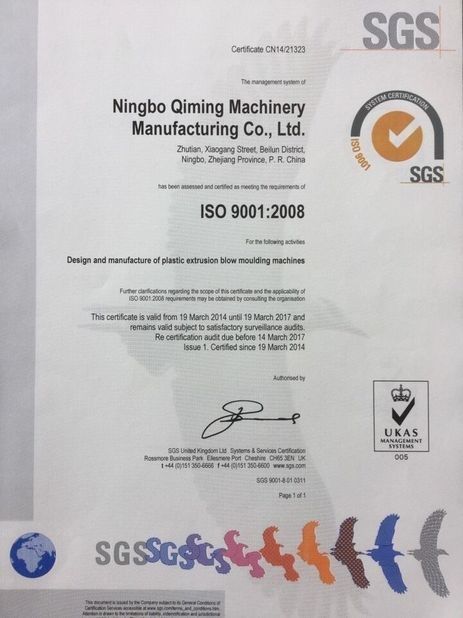
Specifications above are taken from Ningbo Qiming’s MZ series documentation. Cycle times and IV figures are ranges observed on production moulds; your result depends on cavity count, resin grade, cooling water temperature and ambient conditions. We recommend a validated trial on your own tool before committing a line.


 Your message must be between 20-3,000 characters!